European Arts & Disability Cluster
The European Arts & Disability Cluster (ADICLUS) is a European membership network of artists, cultural workers, arts organisations, and cultural institutions committed to advancing equity for Deaf, disabled, neurodivergent, and chronically ill artists and cultural professionals.
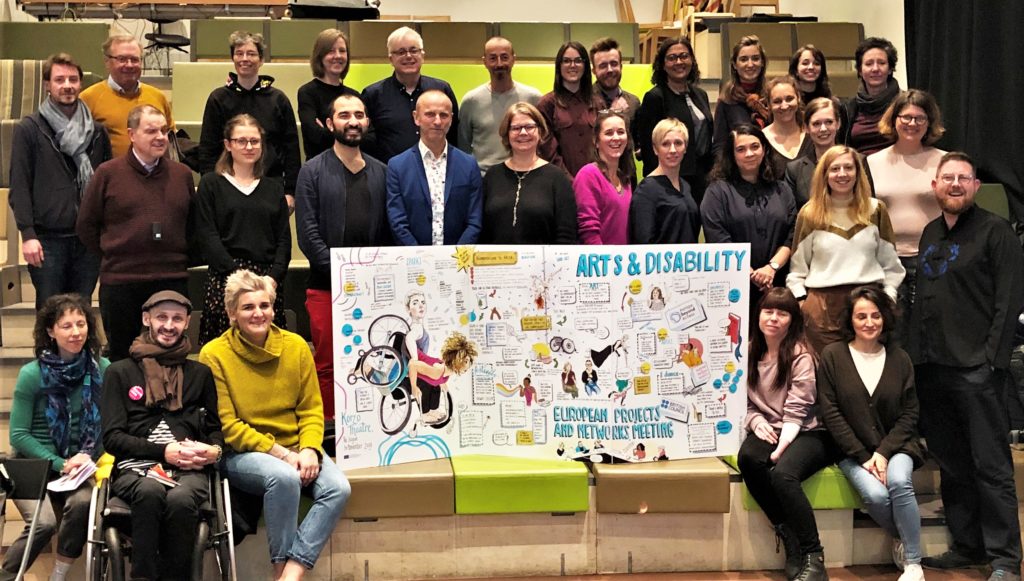
Founded by Europe Beyond Access in 2019 as an informal gathering of people working across Europe to create opportunities for disabled artists and cultural workers, ADICLUS has grown into a vibrant community of 91 members across 27 countries.
In 2026, the network became a registered Belgian non-profit association, with its headquarters in Brussels.
ADICLUS facilitates the exchange of knowledge, experiences, and good practices across borders. It provides a space for members to share information about funding opportunities, accessibility, and strategies for navigating the barriers that continue to affect disabled artists and cultural professionals throughout Europe.
The network also strengthens connections between artists, associations, and institutions, many of whom are pioneering disability-led cultural initiatives in their countries and regions. Through collaboration, members learn from one another as artists, organisers, researchers, and advocates.
At the heart of ADICLUS is a commitment to advocacy. The network works to amplify the voices of Deaf and disabled artists and audiences and to promote greater equity, accessibility, and representation within the European cultural sector.
Originally developed within the framework of Europe Beyond Access, ADICLUS now operates as an independent association while continuing to share a common vision: a cultural landscape in which Deaf, disabled, neurodivergent, and chronically ill artists can thrive, lead, and shape the future of the arts.
ADICLUS has recently changed its legal structure. We are taking the summer to review some of our processes. Check back here in October 2026 to find out more about our activities, how to contact us, and about membership.
In the meantime, Europe Beyond Access remains a key coordinator of the network. If you have an urgent question, please contact info@EuropeBeyondAccess.com
About ADICLUS: Governance
Ben Evans President
Irene van Zeeland (Holland Dance Festival) Vice-President
Abdallah Bahlit Treasurer
Alexander Verveken (Director, Schouwburg Kortrijk) Secretary
Demy Papathanasiou Members’ Representative (Joint)
Filip Pawlak Members’ Representative (Joint)
Kate Brehme Board Member without portfolio
About ADICLUS: Beliefs and Principles
ADICLUS members believe that some of the most interesting and innovative artistic works currently being produced in Europe are being made by artists with disabilities.
ADICLUS members believe that the European cultural ecosystem is fundamentally ableist. The cultural sector includes many significant and structural barriers to equal participation including physical, educational, logistical, knowledge, and financial barriers. Our members work to remove and challenge these barriers.
ADICLUS members work within national contexts which are very disparate. Just as the general experience of people with disabilities is hugely varied across Europe, the specific experience of artists and cultural workers with disabilities is equally varied. We support our members as they seek to improve local conditions. At the same time we highlight examples of best practice from which we think everyone can learn.
ADICLUS members are all involved, in some way, with efforts at a local, national, or transnational level, to improve professional opportunities for artists and cultural workers with disabilities or those who are Deaf. In our different ways, we all advocate for change in the cultural sector.
ADICLUS specifically supports and encourages opportunities for artists and cultural workers at a professional level. We define “professional” as those who are not in full-time education at undergraduate level or below, and who self-identify as artists or cultural workers. Usually, professional work means that payment is exchanged: payment by an audience, and/or payment by a promoter or presenter, and/or payment of the artist or cultural worker themselves.
ADICLUS members are all seeking to position the work of professional artists and cultural workers with disabilities within the professional cultural sector. Although we acknowledge that in some national contexts artists with disabilities have few opportunities to experience culture outside of participatory or amateur contexts (as participants), the aim of the Cluster members is to support a clear trajectory for artists with disabilities within the professional cultural sector.
ADICLUS members believe that artists and cultural workers with disabilities should be paid for their work on an equitable basis with all other cultural workers. We know that very often national welfare and access support payments and services can be endangered when a person with disabilities receives payment for professional services. This is a major risk for arts workers who are often employed with short freelance contracts.
ADICLUS members agree to pay artists with disabilities a fair and equitable wage wherever possible.
ADICLUS members believe that artists and cultural workers with disabilities have an equal right to cultural education as those without disabilities. We observe that lack of access to cultural education is an additional and critical barrier to full and equal access to the arts.
About ADICLUS: Membership
For the moment we are not accepting new members of the Cluster – until we have finalised our new membership processes.
About ADICLUS: Members
Austria
Tanja Erhart
Belgium
European Disability Forum
Fatinha Ramos
Schouwburg Kortrijk
Bulgaria
Art Office Foundation
Cyprus
Ipogia Skini
Croatia
Mario Čaušić
Peti ansambl / The Fifth Ensemble
Czech Republic
Dorotka Papoušek
Denmark
BKF Kunstnere med handicap
Finland
Jenni-Juulia Wallinheimo-Heimonen
Culture for All
Noora Vätinen
France
Centre National pour la Création Adaptée – CNCA (National Center for Adapted Creation)
Onda (L’Office national de diffusion artistique)
Théâtre National de Bretagne
Compagnie de l’Oiseau-Mouche
Thibaut de Martimprey (Bourges 2028)
Cedric Poulain
Georgia
InForm – Platform for Inclusive Minds
Germany
EUCREA e.V.
Kampnagel – Internationales Zentrum für schönere Künste
Kate Brehme
Making a Difference
Un-Label
Festival Theaterformen
Alina Buchberger
Greece
Betina Panagiotara
Demy Papathanassiou
liminal
Maria Koliopoulou
Medie Megas
Onassis Stegi
THEAMA – Inclusive Theater for the Disabled
Hungary
Baltazar Theatre Foundation
ArtMan Association
Iceland
List án landamæra / Art without Borders
Ireland
Blue Teapot Theatre Company
Eoin Nash (He/Him)
Kilkenny Collective for Arts Talent (KCAT)
Project Arts Centre
Italy
Oriente Occidente Impresa Sociale Ets
Jonathan Meth
Fondazione LIA
Lithuania
Kaunas City Chamber Theater
Netherlands
Holland Dance Festival
PodiumINC
Theater Babel Rotterdam
Norway
Aidan Moesby
Bjørn Hatterud
DansiT Choreographic Center
Skuespiller- og danseralliansen AS
Poland
Filip Pawlak
ZAMEK Culture Centre
Portugal
Acesso Cultura | Access Culture
Culturgest – Fundação Caixa Geral de Depósitos
DanÇando com a DiferenÇa
LaB InDança
Raquel André
Terra Amarela
Diana Niepce
Romania
Asociatia Solidart – Basca Theater
Serbia
Saša Asentić
Slovenia
Zavod RISA, Risa Institute
Spain
21distritos
Danza Mobile
David Ojeda
Psico Ballet Maite León Foundation
Mercat de les Flors
MeetShareDance Association
Caitlin Redding
Sweden
Laith Fathulla
Moomsteatern
Riksteatern Crea
ShareMusic & Performing Arts
Skånes Dansteater
Larissa Juni Ferreira
Switzerland
Alessandro Schiattarella
Cie BewegGrund
disframe – Migros Culture Percentage
United Kingdom
Access All Areas
Candoco Dance Company
Deafinitely Theatre
Disability Arts Online
Hijinx
Kimberley Harvey
Unlimited
Check back here soon for a complete list of ADICLUS members
Disability, Deafness and terminology
Social Model of Disability
Our approach is based on the Social Model of Disability. This recognises that people with disabilities and Deaf people are disadvantaged by attitudinal, environmental and systemic barriers in society, not by their impairment or difference. We are working to identify and dismantle these barriers in our sector.
Definition
Our definition of persons with disabilities include those who have long-term physical, mental, intellectual or sensory impairments (such as deafness or visual impairment), chronic illness or Neurodiversity, which, in interaction with various barriers, may hinder their full and effective participation in society on an equal basis with others.
Deaf Identity / Deaf Culture
We acknowledge that many Deaf people reject inclusion within a description of disability – preferring to reference themselves as part of a marginalised language group and a minority culture.
However, our membership, including Deaf members, acknowledge the value of a network committed to reducing barriers in the cultural sector. We also acknowledge that often Deaf awareness and reduction of barriers for Deaf people often goes hand-in-hand with disability awareness and reduction of other barriers.